Blogs

Empowered Tenants Project Final Report: From Awareness to Action to Collective Power

The Regent Park Neighbourhood Association is proud to share the Empowered Tenants Project Final Report: Expanding Legal Knowledge and Justice for Housing Rights, submitted to the Department of Justice Canada.

This report marks an important milestone in RPNA’s ongoing work to strengthen tenant rights, prevent evictions, and build community-led access to justice. The Empowered Tenants Project was designed to support tenants with accessible legal information, practical tools, and trusted community-based support so that residents are better equipped to understand their rights, navigate housing systems, and advocate for themselves and their neighbours.

Read the report here.
Why This Report Matters

Across Toronto, tenants are facing growing housing insecurity, rising rents, maintenance issues, displacement pressures, eviction threats, and complex legal processes. Many tenants know they have rights, but the project found that knowing your rights is not the same as being able to act on them.

The report highlights a critical access-to-justice gap: while many tenants have some awareness of their rights, only a small number reported high confidence in navigating formal legal systems such as eviction processes and Landlord and Tenant Board procedures. More than half of survey respondents reported experiencing housing-related conflict, yet many did not seek support because of fear of retaliation, lack of awareness, and system complexity.

This finding is at the heart of the report: tenants are not simply lacking information. They are navigating systems that are difficult, intimidating, and often inaccessible without support.

What the Project Accomplished

Through the Empowered Tenants Project, RPNA and its partners delivered a comprehensive, community-led public legal education and information initiative rooted in equity, lived experience, and access to justice.

Key activities included:

  • A city-wide Tenant Town Hall with approximately 120 participants;

  • Targeted public legal education workshops for seniors, youth, TCHC tenants, and other tenant communities;

  • More than 40 outreach events;

  • A multilingual tenant rights and legal knowledge survey;

  • Multilingual digital resources and tenant rights videos;

  • Community-based engagement through trusted local networks;

  • The launch of the RPNA Evictions Response Unit in May 2026.

The project reached tenants across different housing tenures, including private market tenants, Toronto Community Housing tenants, rooming/shared housing residents, and tenants experiencing housing precarity.

What Tenants Told Us

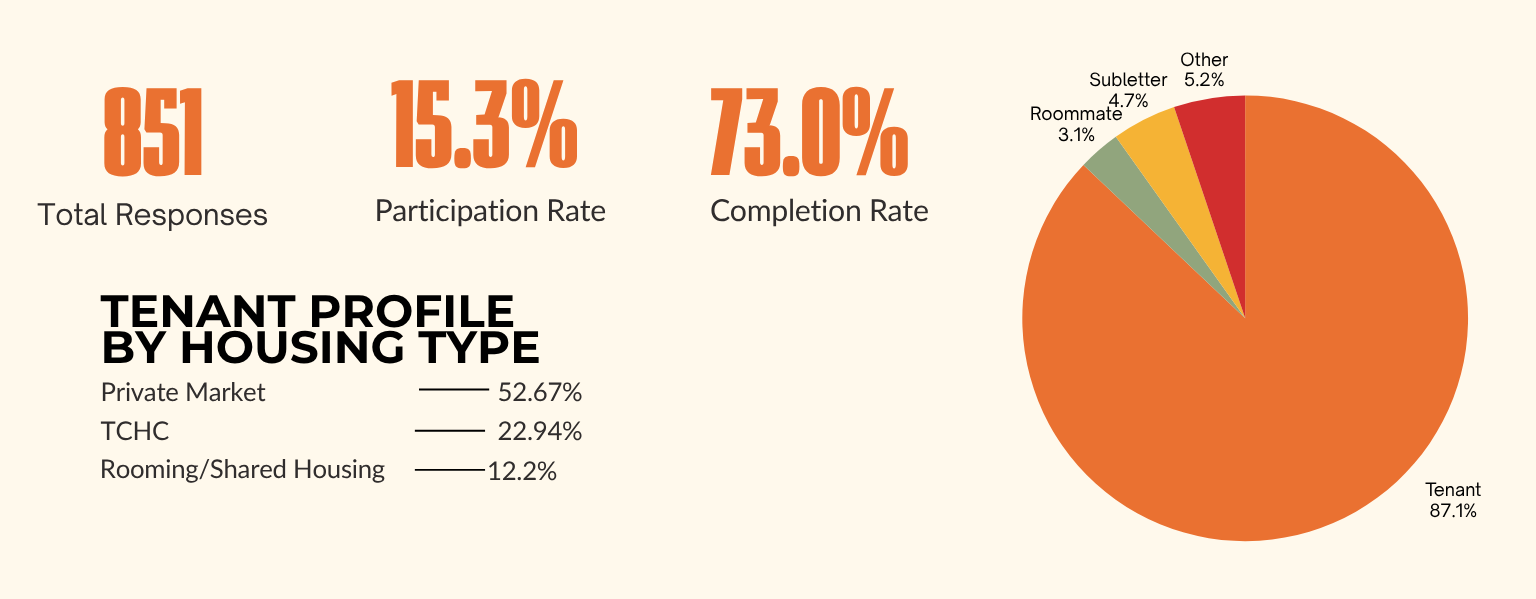
The tenant survey generated a strong community-driven evidence base. The survey received 851 total responses, including 619 completed responses. The findings show that tenants are experiencing significant housing challenges, including unsafe conditions, rent increases, eviction threats, harassment, discrimination, and barriers to accessing support.

The report found:

  • 87.08% of respondents identified as tenants;

  • 52.7% lived in private market rentals;

  • 22.9% lived in Toronto Community Housing;

  • 55.7% had experienced housing-related conflict;

  • Only 12.8% reported high confidence in understanding and navigating their rights;

  • Nearly 80% wanted more tenant education and support.

The top barriers identified by tenants included fear of landlord retaliation, lack of knowledge of rights, lack of awareness of supports, language and access barriers, and time constraints.

These findings confirm the need for accessible, multilingual, plain-language, and community-based supports that go beyond one-time information sessions.
From Awareness to Action

One of the most significant outcomes of the project was the launch of the RPNA Evictions Response Unit in May 2026. The Unit was created to respond directly to the project’s central finding: tenants need support to act on their rights.

The Evictions Response Unit helps turn informal contact, such as a phone call, walk-in, or referral from a trusted neighbour, into a documented file with a pathway for advocacy, representation, or referral.

During the pilot period, the Unit supported:

  • 24 intakes;

  • 13 active advocacy files;

  • 10 referrals to legal and social services;

  • A caseload where three in four files involved social or non-profit housing.

The report emphasizes that documentation has been one of the most effective tools in successful tenant advocacy. Recording every meeting and every commitment made by a housing provider in writing helps tenants hold institutions accountable and follow up when commitments are not met.

Key Community Insights

The report identifies several recurring themes from tenant experiences and casework:

  1. Housing disrepair remains a major issue, with tenants reporting unsafe conditions, delayed maintenance, and limited access to enforcement tools.

  2. Displacement pressures from evictions, renovictions, and gentrification continue to destabilize communities, particularly Black-majority and low-income communities.

  3. Housing affordability is a central driver of precarity, forcing tenants to make difficult trade-offs between rent and basic needs.

  4. Power imbalances discourage tenants from asserting their rights, especially where fear of retaliation and lack of accountability are present.

  5. System navigation barriers prevent tenants from accessing legal processes, completing forms, enforcing orders, and connecting with supports.

  6. Community-based solutions are urgently needed, including peer support, tenant leadership development, and resident-led advocacy.

  7. Women whose housing depends on a partner’s tenancy may face serious housing insecurity when relationships end, particularly where they are not named on the lease.

These insights show that housing justice requires more than legal information. It requires practical support, follow-through, resident leadership, and systemic accountability.

A Community-Led Model for Access to Justice

The Empowered Tenants Project demonstrates that trusted community organizations can play a vital role in improving access to justice. RPNA’s model combines public legal education, resident engagement, multilingual tools, referral pathways, case documentation, tenant advocacy, and systemic monitoring.

The report recommends a next phase that includes:

  • A Community-Based Eviction Response Team;

  • A Tenant Legal Navigation Hub;

  • A Tenant Advocate and Peer Leader Program;

  • Expanded scenario-based public legal education;

  • A systemic advocacy and monitoring function.

This model is designed to support earlier intervention, reduce eviction risk, increase tenant confidence, and strengthen housing stability before matters escalate into crisis.

Gratitude to Our Partners

RPNA is deeply grateful to the Department of Justice Canada for supporting the Empowered Tenants Project through the Justice Partnership and Innovation Program – Tenant Protection Fund.

We also acknowledge the many community partners, tenant advocates, legal service providers, residents, staff, and volunteers who contributed to this work. This project was made possible through collaboration, trust, and a shared commitment to housing justice.

The Path Forward

The Empowered Tenants Project Final Report makes one thing clear: tenants are not lacking awareness. They are navigating a system that is structurally complex, inequitable, and difficult to access.

The path forward is clear:

From awareness → action → collective power.

With continued investment and partnership, the Empowered Tenants Project offers a scalable, community-driven model to strengthen tenant rights, improve housing stability, prevent evictions, and advance a more equitable housing system across Toronto and beyond.

RPNA remains committed to building tenant leadership, supporting residents at risk of eviction, and working with community partners to ensure that every tenant has the knowledge, tools, and support they need to remain safely housed.


​ ​
  • Empowered Tenants Project Final Report: From Awareness to Action to Collective Power

    The Regent Park Neighbourhood Association is proud to share the Empowered Tenants Project Final Report: Expanding Legal Knowledge and Justice for Housing Rights, submitted to the Department of Justice Canada.

    This report marks an important milestone in RPNA’s ongoing work to strengthen tenant rights, prevent evictions, and build community-led access to justice. The Empowered Tenants Project was designed to support tenants with accessible legal information, practical tools, and trusted community-based support so that residents are better equipped to understand their rights, navigate housing systems, and advocate for themselves and their neighbours.

    Read the report here.

    Why This Report Matters

    Across Toronto, tenants are facing growing housing insecurity, rising rents, maintenance issues, displacement pressures, eviction threats, and complex legal processes. Many tenants know they have rights, but the project found that knowing your rights is not the same as being able to act on them.

    The report highlights a critical access-to-justice gap: while many tenants have some awareness of their rights, only a small number reported high confidence in navigating formal legal systems such as eviction processes and Landlord and Tenant Board procedures. More than half of survey respondents reported experiencing housing-related conflict, yet many did not seek support because of fear of retaliation, lack of awareness, and system complexity.

    This finding is at the heart of the report: tenants are not simply lacking information. They are navigating systems that are difficult, intimidating, and often inaccessible without support.

    What the Project Accomplished

    Through the Empowered Tenants Project, RPNA and its partners delivered a comprehensive, community-led public legal education and information initiative rooted in equity, lived experience, and access to justice.

    Key activities included:

    • A city-wide Tenant Town Hall with approximately 120 participants;

    • Targeted public legal education workshops for seniors, youth, TCHC tenants, and other tenant communities;

    • More than 40 outreach events;

    • A multilingual tenant rights and legal knowledge survey;

    • Multilingual digital resources and tenant rights videos;

    • Community-based engagement through trusted local networks;

    • The launch of the RPNA Evictions Response Unit in May 2026.

    The project reached tenants across different housing tenures, including private market tenants, Toronto Community Housing tenants, rooming/shared housing residents, and tenants experiencing housing precarity.

    What Tenants Told Us

    The tenant survey generated a strong community-driven evidence base. The survey received 851 total responses, including 619 completed responses. The findings show that tenants are experiencing significant housing challenges, including unsafe conditions, rent increases, eviction threats, harassment, discrimination, and barriers to accessing support.

    The report found:

    • 87.08% of respondents identified as tenants;

    • 52.7% lived in private market rentals;

    • 22.9% lived in Toronto Community Housing;

    • 55.7% had experienced housing-related conflict;

    • Only 12.8% reported high confidence in understanding and navigating their rights;

    • Nearly 80% wanted more tenant education and support.

    The top barriers identified by tenants included fear of landlord retaliation, lack of knowledge of rights, lack of awareness of supports, language and access barriers, and time constraints.

    These findings confirm the need for accessible, multilingual, plain-language, and community-based supports that go beyond one-time information sessions.

    From Awareness to Action

    One of the most significant outcomes of the project was the launch of the RPNA Evictions Response Unit in May 2026. The Unit was created to respond directly to the project’s central finding: tenants need support to act on their rights.

    The Evictions Response Unit helps turn informal contact, such as a phone call, walk-in, or referral from a trusted neighbour, into a documented file with a pathway for advocacy, representation, or referral.

    During the pilot period, the Unit supported:

    • 24 intakes;

    • 13 active advocacy files;

    • 10 referrals to legal and social services;

    • A caseload where three in four files involved social or non-profit housing.

    The report emphasizes that documentation has been one of the most effective tools in successful tenant advocacy. Recording every meeting and every commitment made by a housing provider in writing helps tenants hold institutions accountable and follow up when commitments are not met.

    Key Community Insights

    The report identifies several recurring themes from tenant experiences and casework:

    1. Housing disrepair remains a major issue, with tenants reporting unsafe conditions, delayed maintenance, and limited access to enforcement tools.

    2. Displacement pressures from evictions, renovictions, and gentrification continue to destabilize communities, particularly Black-majority and low-income communities.

    3. Housing affordability is a central driver of precarity, forcing tenants to make difficult trade-offs between rent and basic needs.

    4. Power imbalances discourage tenants from asserting their rights, especially where fear of retaliation and lack of accountability are present.

    5. System navigation barriers prevent tenants from accessing legal processes, completing forms, enforcing orders, and connecting with supports.

    6. Community-based solutions are urgently needed, including peer support, tenant leadership development, and resident-led advocacy.

    7. Women whose housing depends on a partner’s tenancy may face serious housing insecurity when relationships end, particularly where they are not named on the lease.

    These insights show that housing justice requires more than legal information. It requires practical support, follow-through, resident leadership, and systemic accountability.

    A Community-Led Model for Access to Justice

    The Empowered Tenants Project demonstrates that trusted community organizations can play a vital role in improving access to justice. RPNA’s model combines public legal education, resident engagement, multilingual tools, referral pathways, case documentation, tenant advocacy, and systemic monitoring.

    The report recommends a next phase that includes:

    • A Community-Based Eviction Response Team;

    • A Tenant Legal Navigation Hub;

    • A Tenant Advocate and Peer Leader Program;

    • Expanded scenario-based public legal education;

    • A systemic advocacy and monitoring function.

    This model is designed to support earlier intervention, reduce eviction risk, increase tenant confidence, and strengthen housing stability before matters escalate into crisis.

    Gratitude to Our Partners

    RPNA is deeply grateful to the Department of Justice Canada for supporting the Empowered Tenants Project through the Justice Partnership and Innovation Program – Tenant Protection Fund.

    We also acknowledge the many community partners, tenant advocates, legal service providers, residents, staff, and volunteers who contributed to this work. This project was made possible through collaboration, trust, and a shared commitment to housing justice.

    The Path Forward

    The Empowered Tenants Project Final Report makes one thing clear: tenants are not lacking awareness. They are navigating a system that is structurally complex, inequitable, and difficult to access.

    The path forward is clear:

    From awareness → action → collective power.

    With continued investment and partnership, the Empowered Tenants Project offers a scalable, community-driven model to strengthen tenant rights, improve housing stability, prevent evictions, and advance a more equitable housing system across Toronto and beyond.

    RPNA remains committed to building tenant leadership, supporting residents at risk of eviction, and working with community partners to ensure that every tenant has the knowledge, tools, and support they need to remain safely housed.
  • Now Hiring: Canada Summer Jobs at RPNA

    NOW HIRING: Canada Summer Jobs at RPNA! 

    Looking for meaningful summer work that makes a difference? The Regent Park Neighbourhood Association is hiring for 3 paid Canada Summer Jobs positions:

    •  Community Organizer
    •  Digital Marketing Coordinator
    •  Financial Administrator

    Job Details:

    •  35 hours/week
    •  8-week contract
    •  $18/hour

    If you’re passionate about community-building, social justice, communications, and creating positive change, we want to hear from you.

     Send your Cover Letter + Resume to:RPNA.INFO@GMAIL.COM

     Deadline: May 4, 2026 at 11:59 PM

    Learn more: https://www.regentparkna.ca/jobs_csj_rpna_2026

    Follow us: @regentpark.rpna

    Please share with youth, students, and emerging leaders in your network!

  • Keep TCHC Tenants Housed: Show Your Support for an Eviction Moratorium

    Advancing Housing Stability: Proposed Eviction Moratorium at City Hall

    As Toronto continues to face a deepening housing crisis, an important motion is moving forward that could provide immediate relief to some of the city’s most vulnerable tenants.

    Between 2023 and 2025, evictions in Toronto Community Housing have increased by more than 100%, harming the most vulnerable communities in the city. Evictions from social housing disproportionately impact Black, Indigenous, racialized, and low-income tenants, as well as seniors, families, youth, and persons with disabilities.

    A recommendation has been advanced for the implementation of a moratorium on arrears-related evictions in Toronto Community Housing, proposed to take effect from July 30, 2026 to November 15, 2026. This temporary pause is intended to create the necessary space for City Council to review and adopt a comprehensive, equity-focused plan to address the alarming rise in evictions across the system.

    This recommendation will be considered by the Economic and Community Development Committee on April 9th, 2026, marking a critical opportunity for residents, advocates, and community leaders to engage in the decision-making process and push for meaningful action on housing stability and equity.

  • Eviction Crisis in Social Housing: An Analysis

    Analysis of Evictions from Social Housing


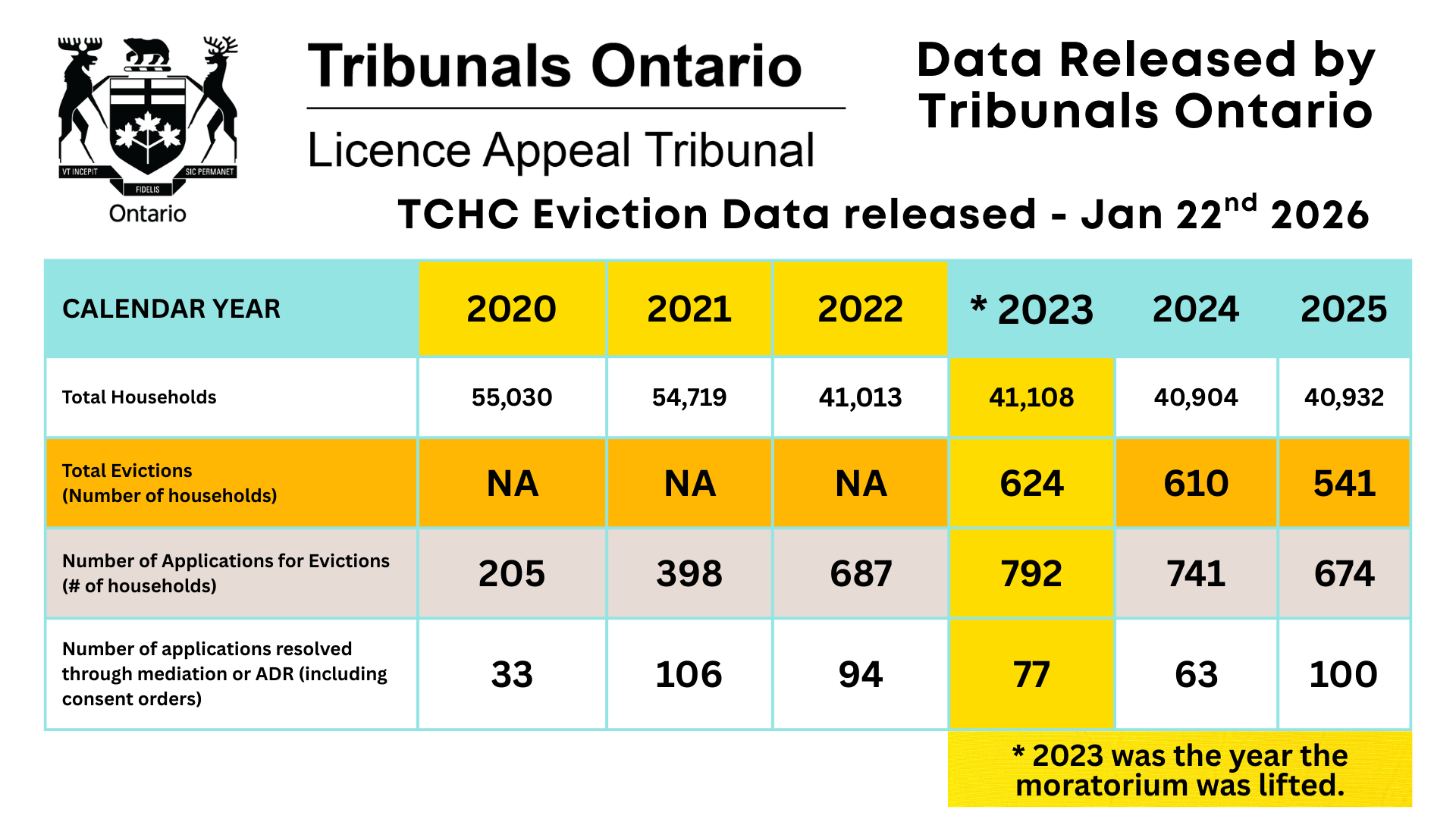
    This analysis is based on data obtained through FIPPA Disclosure LTB-25-033-F (Access Decision dated January 22, 2026), alongside publicly reported figures. It identifies significant trends and reporting discrepancies in eviction data affecting Toronto Community Housing Corporation (TCHC) tenants.

    Evictions Have Increased Dramatically

    Even using TCHC’s own reported figures, evictions have more than doubled in just two years, while the total number of tenant households has declined.

    Evictions from social housing increased by over 100% in two years, alongside the persistence of “hidden evictions”,  including coerced lease removals and informal displacement that never appear in official statistics.

    Evictions trigger homelessness, family separation, long-term trauma, and deep community destabilization.

    Social housing evictions are preventable.


    Highest Post-Moratorium Evictions on Record - 2023. 

    • Evictions recorded by Tribunals Ontario (2023): 624

    • Evictions publicly reported by TCHC (2023): 162

    • Difference: 462 additional households

    Percentage Increase:
    (462 ÷ 162) × 100 = 285% higher than publicly reported by TCHC.

    2023 represents the worst post-moratorium year for TCHC tenants.

  • Framework to Prevent Displacement and Advance Income-Based Affordable Housing

    November 2025 – Submission to The Honourable Evan Solomon, Minister of Artificial Intelligence and Digital Innovation

    The Regent Park Neighbourhood Association (RPNA) and the Regent Park Tenant Rights Association (RPTRA) have jointly submitted a policy framework urging all levels of government to adopt income-based definitions of affordability and prevent displacement in revitalizing communities.

    RPNA and RPTRA members meet with MP Solomon

  • Job Opportunities for Youth: City of Toronto April 2025

    The City of Toronto is hiring youth age 16+ to help run its afterschool programming! This is a part-time position, to plan, lead and organize Ministry directed After-School Recreation Care (ARC) Programs for children (6-12 years) providing on-site program direction.

  • Dundas Sherbourne Revitalization Survey

    The Dundas–Sherbourne Neighbourhood Revitalization Plan focuses on creating social and economic equity for community members as the neighbourhood grows and develops. The plan aims to ensure that current and future residents, local groups, organizations and businesses are supported as the area is developed over time.